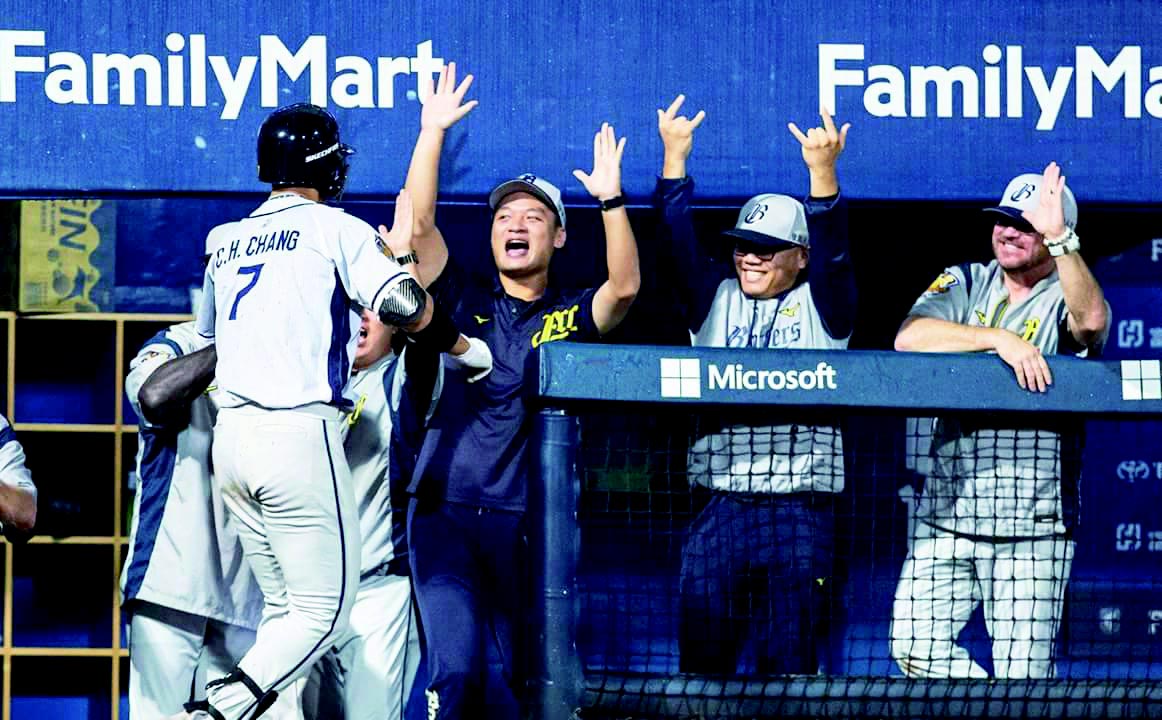
While it’s the players that everyone focuses on during the heated excitement of a professional baseball game, one must not forget that this wouldn’t be possible without nonstop efforts by a small army of support personnel. At Brothers Baseball Club, this behind-the-scenes support team includes a small group whose jobs are absolutely critical to success—the team interpreters. Currently, there are four full-time interpreters on the staff, one each assigned to Team Manager Scott Budner, Batting Coach Terry Alexander and Pitching Coach John Foster, with another working with the team’s three foreign players. Alexander’s interpreter is Fielder Kuo, who has assisted the batting coach over the past year and, during the year prior, worked with Alexander’s predecessor, Jim Presley. Despite the demands of a job that sees him shadowing Alexander all week long during and in between games, Kuo handles his responsibilities with confidence.
The Taipei native had no idea that his life would take such a course when he entered Chinese Culture University as an English major freshman. A physical education class professor who also served as pitching coach for the university team knew the Chinese Taipei Baseball Association (CTBA) international affairs manager. When the CTBA needed an interpreter for a 2014 international tournament in Taichung, the professor asked Kuo if he could help. A baseball fan, Kuo agreed and ended up working in this part-time role throughout his college years.
“To be truthful, I didn’t expect to become an interpreter as a college freshman. I didn’t have this much confidence even though I majored in English. But once I tried it again and again, I learned a lot of things,” he says, adding that some interpretation classes helped boost his English writing and speaking skills and confidence. “I made my mind up to be an interpreter by my sophomore year.”
After graduation, he saw that Brothers had an open team interpreter position and got his first full-time job. Two years in this role and four college years of experience have seen his skills improve tremendously, including familiarity with American baseball/sports slang and expressions like a “jimmy jack” (3-run homer), a pitcher with a “juicy arm” (fast pitching arm) or “this game is wrapped” (a sure win). As a full-time part of the team he handles two-way translation during training, meetings, games and elsewhere, as well as the compilation of hitter game-statistic charts for Alexander. “I get on the team bus around 1 p.m. and get home around 11 or 12 o’clock. If I have to translate a post-game report, that’s another hour of work after that,” he says, adding that he also regularly assists Alexander and his family with non-baseball matters, whether it’s showing them around Taichung or helping when someone gets sick.
“They treat you as their family so you want to help. As an interpreter, I’ve always had the principle that whoever you work with, you see them as your family. That’s how I stay professional and passionate. You can’t say, ‘That’s not my job. That’s your own business.’ So I’ve always had close relationships with my ‘interpretees’,” he explains, noting that he spent a month at Jim Presley’s home in Panama City Beach, Florida at the former coach’s invitation. For him, the biggest challenge is how to translate the coach’s words appropriately: “People talk with emotion and sometimes you need that emotion [in interpretation] and sometimes you don’t. Let’s say a player is arguing with the coach and it looks like a conflict is coming. Do you think that’s the appropriate time to add more emotion? I don’t think so. This depends on our experience. We can really notice the atmosphere, whether it’s good or bad…. If they’re arguing and really mad, I should probably hold back to prevent more conflict.”
Although a good percentage of Taiwanese players have a decent understanding of English—like relief pitcher CC Lee, who played nine years of US Major League Baseball—an interpreter is still essential when coaches are talking to players about pitching/batting mechanics and other key points, and in double-checking everyone’s understanding. On the lighter side, Kuo remarks that most of the Taiwanese players have picked up English nicknames, often given by foreign teammates, like No. 14 shortstop Wang “Subway” Seng-wei, No. 9 third baseman Wang “Stick” Wei-chen and No. 7 centerfielder Chang “Hollywood” Chih-hao. Despite the various challenges and tiring schedule, Kuo says he loves his job: “It’s baseball, my favorite sport. When your hobby is your job and you come to the stadium and watch games for your job, how amazing is that?”
當觀眾在熱鬧沸騰的棒球賽中專注於球員時,絕對不該忘記一群辛苦的工作人員,因為若是沒有他們,一場球賽也無法順利舉辦。然而,在中信兄弟俱樂部的幕後人員還包含一小群比賽中的關鍵人物,他們就是球隊翻譯員。
目前隊上有4位全職翻譯人員分配給總教練伯納S.B 、打擊教練泰銳T.A、投手教練佛斯特J.F與3位外籍球員。泰銳的翻譯員是郭庭綸,他也同時為往年的打擊教練 (Jim Presley)協助翻譯。雖然整個禮拜(包含球賽中)都需與泰銳合作,郭庭綸仍能相當地自信心承擔此項工作任務。
台北當地的人完全料想不到文化大學英語系新生能勝任這番工作,這一切都源由此校體育教授 (同時也是校隊投手教練)與中華民國棒球協會的國際事務經理的相識。當中華民國棒球協會於2014年在台中舉辦的國際賽事需要一位翻譯員時,這位教授便詢求郭庭綸協助,身為棒球迷的他,立馬答應並以半工半讀方式擔任此職務。
「老實說,我並不期待能以大學新鮮人身分成為一位翻譯員。雖然主修英文,但是我並沒很多信心。但當我自己不斷嘗試之後,我學了許多事物。」他也提到一些翻譯課程也幫助他在英文書寫與口說方面的幫助,使他更有自信。「我在大學二年級時決定成為一位翻譯員。」
在畢業之後,他得知中信兄弟有一翻譯職缺,並將之成為他的首份全職工作。這兩年的工作與4年大學累積的經驗使得他在翻譯上的技巧突飛猛進,其中更熟悉美式棒球/運動俚語;像是三分全壘打jimmy jack、速球之臂juicy arm與這場球贏定了this game is wrapped等表達方式。
身為球隊的全職工作者,他需在訓練、會議、比賽時處理雙向翻譯,同時還得為泰銳整理一連串比賽的數據表格。「我下午1點搭上球隊巴士,晚上11~12點回家。如果我需要為賽後報告翻譯,那就在晚一點休息。」他也同時為泰銳與他家人處理非棒球相關事務,包含導覽台中的工作與病痛照料一事。
「他們將你當作家人一般,所以自然地會想幫這些外國人。身為翻譯員,我總有一項原則,那就是與你工作的人就是你的家人,這也讓我越來越專業與充滿工作熱忱。你不能說那不是我的工作,所以我總與外國人保持良好關係。」他也說道自己受前打擊教練邀請,並在他位於佛羅里達巴拿馬濱海城市的家待上一個月的時間。
對他來說最大的挑戰便是如何正確翻譯教練所說的話,「當人說話帶情緒時,你也需要辨識是否該將此感覺表達出來,好比說一位教練正在跟教練吵架,你認為這時該多帶情緒進入翻譯內容嗎?自然不會。當然這也得靠經驗判斷,因為我們得認真感覺當下氛圍是否好壞。如果大家情緒激烈地表達自己想法時,我則需要冷靜溫和做翻譯角色以防帶來更多紛爭。」
雖然大部分台灣球員對英文理解有相當的程度,就如一位在美國大聯盟打9年球的李振昌雖有基本英文溝通能力,但當教練使用投打術語與重點時,翻譯人員仍須再次確認球員對於教練提點部分的理解。郭翻譯員也提到較為輕鬆的球隊生活內幕,大部分的台灣球員都有英文綽號,而這些都取自於外國球員們。例如背號14號的王勝偉叫做Subway、9號三壘手王威晨是Stick,而7號外野手張志豪則叫做Hollywood。
除了多項挑戰與令人疲乏的賽程,郭庭綸說他仍愛他的工作。「這是棒球,也是我最愛的運動。當這是你的興趣,而且又能到球場看球,是多棒的事情啊!」