History and background
The current site for Taichung’s newest and largest park has a very interesting and varied background. During the Japanese colonial era, it was utilized as the then Taichu Prefecture’s only commercial airport and later became Taichung’s Shuinan Airport, used for both military and civilian flights. From 1946 it has also served as an important hub for Taiwan’s aerospace industry. All this changed in 2004, when Taichung International Airport opened at Ching Chuan Kang Air Base, leading Taichung City Government to redesignate the old site as the Shuinan Economic and Trade Park (a.k.a. Taichung Gateway Park) in 2007. According to plans, this development will eventually host not only Central Park, but also an international convention and exhibition center, and “museumbrary” (museum and library). This venue will also include an ecological park with a renewable energy and smart management system, business park, and university-related facilities. Those who still don’t have a clear idea of where this park is located may recall another claim to fame, as this is where the movie “Life of Pi” was in large part filmed by director Ang Lee.
Construction of Taichung Central Park began in 2014, and was partially opened to the public in November, 2018 for the launch of the Taichung Flora Exposition, and now is fully completed.
An eco-friendly, smart park
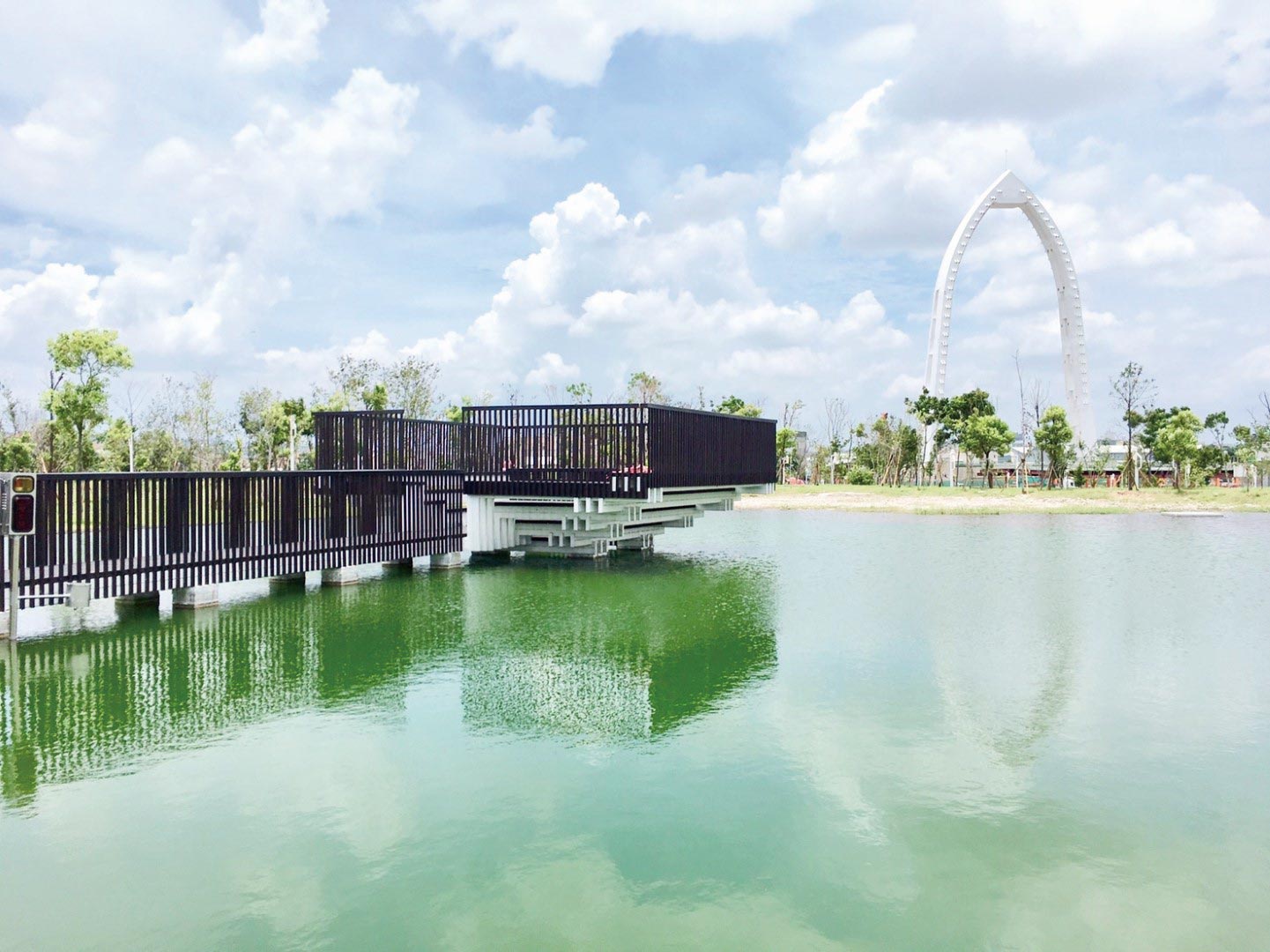
With a budget of NT$2.7 billion, the 67-hectare Central Park is also being referred to as the “lungs of Taichung”. World-renowned architects Catherine Mossbach and Philippe Rahm proposed an ambitious and innovative series of microclimates as the guiding thought behind their “Atmospheres of Wellbeing” proposal for the park. These microclimates, scattered throughout the linear site, are to be the product of natural and artificial devices. The exterior climate of the park is thus modulated so to create spaces that are less hot, less humid, and less polluted.
The public can download a “台中中央公園” (Taichung Central Park) app for the latest updated information, obtained via 162 microclimate sensors in the park. These systems, together with the park’s concepts of low-carbon, smart management and innovation can also adjust its climate via natural sources, including abundant trees, geology and air flow. There are 10,000 square meters of solar panels installed on the southern and northern sides of the parking lot, as well as five water-regeneration sites to collect rainwater and reuse it to nurture park plants.
Green, ecological pathways
Three color-coded main paths (Cool Path, Dry Path, Clean Path) connect all these specific park climatic zones, offering a diversity of promenades, from the flat Clear Path to the more athletically-challenging Dry Path. At night, colored lights differentiate the paths as well. A gradual densification of trees, including maple, eucalyptus, sap and other arbor trees, can be seen along the paths, providing shade. Chinese banyan trees around the Dry Path help absorb humidity at the ground level. You may also see squirrels and black-shouldered kite birds on the branches of Pistacia chinensis, Qinggang, and Looking Glass trees around the Clear Path. This natural setting creates a perfect environment for fireflies and egrets as well.
Experiencing the park with ’12 senses’
Twelve park pavilions are designed in relation to the “12 senses”, allowing visitors to experience extraordinary, poetic and playful sensory inputs. This is derived from Waldorf Education’s philosophical concept of working with the 12 senses of touch, life, movement, balance, smell, taste, sight, temperature, hearing, speech, thought, and ego. This belief in the 12 senses also notes, “These senses enable us to perceive the external world while we are here in the physical world.”
The first brown-colored, four-story pavilion is called “Self-exploration” and formed out of layers of wood. “Listening-exploration” is another pavilion that comes with three-note wind chimes; “Balance-exploration” is an interesting pavilion that literally “flows in the air” while “Speech-exploration”, built in the Tien-Chi Center that comes with a scenic pond (天池中心), is a wooden pavilion providing a leisurely setting for visitors to chat and communicate. There are many other spots to explore in this eco-friendly park, whose scenery changes according to the varying seasons, climates and times.
交通資訊 Transportation information
停車:水湳智慧城中央停車場小型車停車以每半小時10元計費,機車每次停車收費20元
Parking: Paid parking for cars is NT$10 per 30 minutes, and NT$20 per motorcycle per visit.
公車:
停靠站-河南停車場、家扶發展學園
Bus stop: Henan Parking, Taiwan Fund For Children and Families
台中客運 Taichung Bus: No. 28, 54
仁友客運 Ren Yo Bus: No. 32
四方客運 SF E-bus: No. 68
捷順交通 J.S Bus: No. 199
豐榮客運 Green Transit Bus: No. 228
停靠站-泰安國小(環中路)
Bus stop: Tai An Elementary School (HuanZhong Road) 156
台中客運 Taichung Bus:No. 156
歷史前身
原為水湳機場建於歷史悠久的日治時代,曾經為軍用機場,屬臺中州境內唯一的民用飛機場,直到1946年國民政府接收後,成為臺灣航空製造、試飛的基地。直至2004年臺中航空站為升格國際機場遷至清泉崗空軍機地,2007年底空軍水湳機場移交給台中市政府並規劃水湳經貿園區 (亦稱水湳智慧城),其中大型公共設施包括中央公園,尚有國際會展中心、臺中綠美圖 (市立圖書館、市立美術館),以「生態園區」概念,打造智慧城專用區、生態住宅專區、文化商業專用區、創新研發專用區及文教區等5大園區,如果你不知道在哪裡?還記得2011年李安導演為了拍攝「少年PI的奇幻漂流」,就是選擇水湳機場作為電影團隊進駐拍攝的片場,而公園直至2014年才開始建設,2018年11月因應台中花博開幕開放部分區域,目前己全區完工。
生態智慧公園
號稱「台中之肺」的水湳中央公園,總面積達 67公頃,造價逾27億,由國際知名建築師Catherine Mosbach、Philippe Rahm Architects及劉培森建築師事務採「生態工法」創造出台中市區內最大都市森林,其概念以自然生態環境做為出發,營造生態多樣性的棲地,公園共有162支微氣候感測器,可偵測該區的溫度、溼度、污染三個參數,可下載「台中中央公園」app即時更新現況,公園的智慧功能也將調節區域內微氣候,利用天然原生樹種以及大量樹木、順著地形起伏引進氣流等自然方式設計,保護自然生態,調節公園內的氣候,為實踐其「低碳」、「智慧」、「創新」的設計理念,園內設置於南、北側停車場上方有一萬平方公尺的太陽能光電版,是全球第一個能源自主的公園,依地形設置5座滯洪池,兼具雨水暫時儲存及蓄水防洪功能,並有水資源中心供應回收用水作為公園內灌溉水源。
步道路線生機盎然
園內高低起伏的地形,形塑出綠帶與休憩空間,規劃了休憩、運動及親子3條步道,休憩步道種植樹冠濃密的槭樹、樟樹、山欖等喬木提供良好遮蔭,運動步道周邊的榕樹會吸收土地濕氣,樹梢已可見松鼠出沒及黑翅鳶,親子步道周邊種植黃連木、青剛櫟及銀葉樹等淨化空氣樹種,有利於螢火蟲、白鷺鷥活動,隨動植物生命的循環,公園的面貌也將呈現出多元的空間樣貌,夜間遊園時三條路線使用不同顏色柔和燈光照明。
十二種感官體驗空間
導入華德福教育(Waldorf Education)哲學理念:談論、味覺、聽覺、平衡、思考、視覺、動態、自我、觸覺、溫暖、嗅覺和生活的十二種感官體驗空間,他們認為「透過感官的開啟,我們認識這世界。除了接受訊息之外,我們也主動探索世界。」,最早完工的「自我體驗區」是一座直立式深咖啡色木條構造的4層樓瞭望台,迷宮式的木造建築交疊交錯而成,「聽覺體驗區」由高中低三種音頻的風鈴構成,感受漂浮於半空中的「平衡體驗區」也很有趣,「談論體驗區」設置於天池中心的木製平台,提供休憩、對話與交流,園區還有更多的空間需要你實際走訪開啟感官之旅,可貴的生態森林公園,地景將隨著四季、氣候、歲月而變化。
交通資訊 Transportation information
停車:水湳智慧城中央停車場小型車停車以每半小時10元計費,機車每次停車收費20元
Parking: Paid parking for cars is NT$10 per 30 minutes, and NT$20 per motorcycle per visit.
公車:
停靠站-河南停車場、家扶發展學園
Bus stop: Henan Parking, Taiwan Fund For Children and Families
台中客運 Taichung Bus: No. 28, 54
仁友客運 Ren Yo Bus: No. 32
四方客運 SF E-bus: No. 68
捷順交通 J.S Bus: No. 199
豐榮客運 Green Transit Bus: No. 228
停靠站-泰安國小(環中路)
Bus stop: Tai An Elementary School (HuanZhong Road) 156
台中客運 Taichung Bus:No. 156