By Steven Crook
To catch glimpses of Taiwan as it used to be, few places are better than Lukang (鹿港). Between the first quarter of the 18th century and the middle of the 19th century, this coastal town—27 kilometers southwest of central Taichung as the crow flies—was second only to the former capital Tainan as a population center and hub of commerce.
Until silt blocked Lukang’s harbor, thousands of ships docked here each year. They brought cloth, dried fish, and herbs from China and carried Taiwanese rice to the mainland. The thoroughfare now called ZhongShan Road (中山路) was once so narrow, with shops’ awnings blocking the sunlight, that locals nicknamed it “See-No-Sky Street” (不見天街). After Japan took control of Taiwan in 1895, the colonial authorities widened ZhongShan Road and several other streets, but the glorious temples and merchant abodes built during the town’s heyday remain intact—and the best way to see them is on foot or by bicycle (Lukang has several YouBike rental points).
Spared the redevelopment that has erased much of Taipei’s character, Lukang boasts an exceptional number of alluring old buildings. Many of them are on PuTou Street (埔頭街) and YaoLin Street (瑤林街), conjoined lanes together known as Lukang Old Street (鹿港老街). Another standout is the Lukang Ding Mansion (鹿港丁家古厝), built in 1893 at the behest of Ding Shou-quan (丁壽泉). Ding brought glory to his clan by attaining success in China’s imperial civil service examinations. There’s no sign of it within the mansion, but the Dings—like many other old Lukang families—were descended from Muslim traders who moved here from the coast of China more than 250 years ago. Not far from the mansion, a little-visited temple stands where the first mosque in Taiwan was established back in the 18th century. It looks no different to thousands of other shrines around the country, yet it’s said that many worshippers, knowing there used to be an Islamic hall of worship here, exclude pork from the offerings they make.
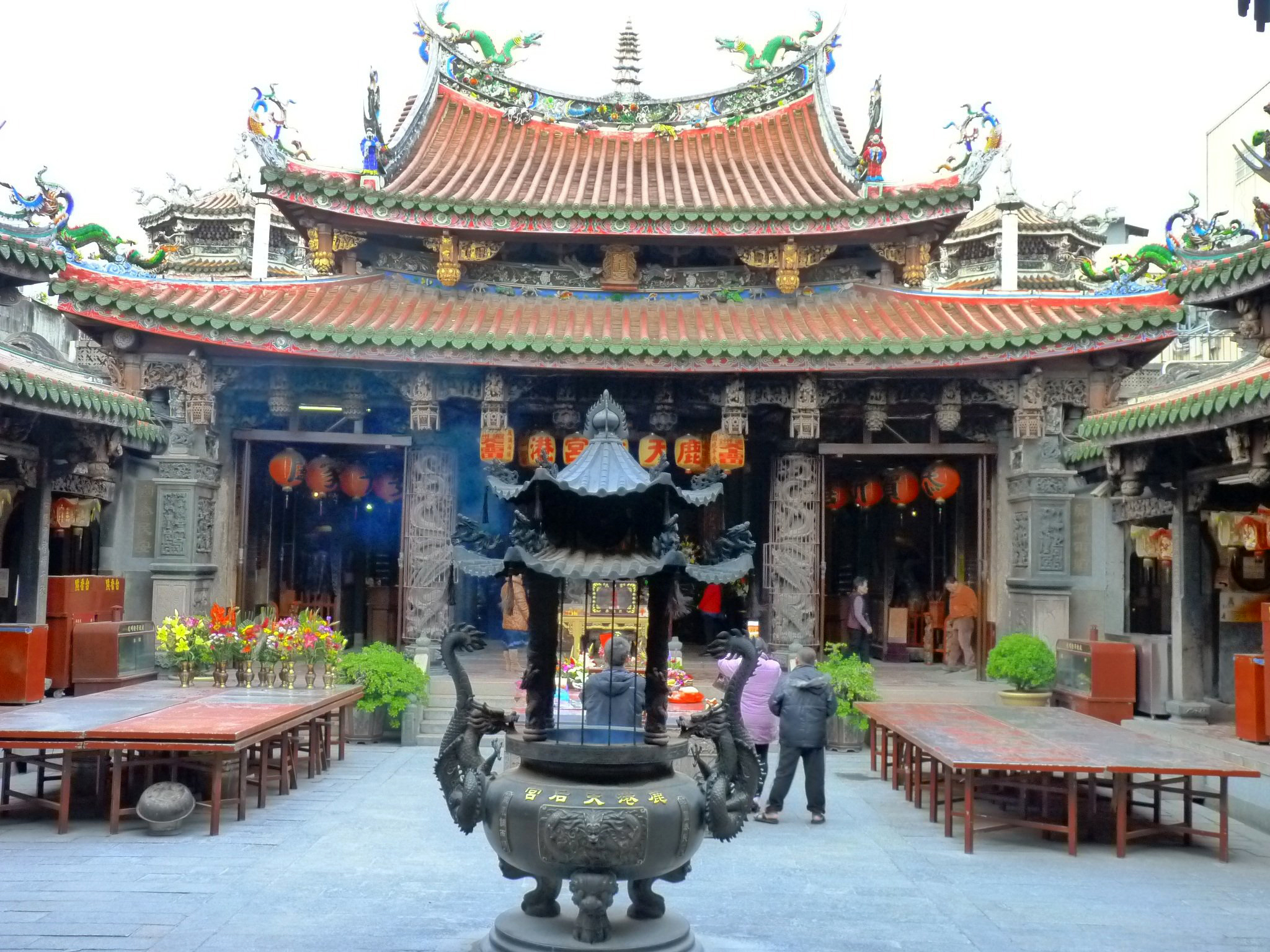
Lukang’s two must-visit religious sites are Longshan Temple (龍山寺) and Tianhou Temple (天后宮). The former is an exquisite and spacious Buddhist shrine. Pay particular attention to the fabulously ornate ceiling, its 99 doorways, and the carved-wood screens. The latter, unfailingly crowded with pilgrims and often deafeningly noisy, is devoted to the cult of Matsu (媽祖). Officially the sea goddess, she’s now revered as a generalist deity by millions of Taiwanese.
If you’re traveling with children, you may want to add Yuqu Temple (玉渠宮) to your itinerary. When this small but delightful shrine was updated some years back, the management committee commissioned paintings of SpongeBob SquarePants, Patrick Star, Mickey Mouse and Japanese cartoon icon Doraemon. Each image is no bigger than a smartphone, and positioned on a high beam at the very front of the shrine, so finding them might take you a minute or two. There’s a good reason why they’re here: Yuqu Temple’s principal deity is Marshal Tian Du (田都元帥), the god of performers and drama. The temple is less than 100 meters south of the No. 1 Market (第一市場), where vendors sell an intriguing selection of traditional snacks, some of which incorporate locally-grown taro.
To get away from the sunshine, and see some truly engrossing artifacts, head for Lukang Folk Arts Museum (鹿港民俗文物館). Located a few minutes’ walk east of the old street, this collection of books, musical instruments, antique furnishings and traditional garments is housed in an imposing 104-year-old baroque mansion. Both the building and many of the exhibits were donated by the Koo family, even now one of Taiwan’s most important business clans. Admission is NT$130/70; see www.lukangarts.tw for opening hours and other details.
GETTING THERE
Lukang is nowhere near a high-speed rail (HSR) or conventional train (TRA) station, yet getting here by public transportation is straightforward. The No. 6936 bus leaves Taichung HSR Station for Lukang every hour on the hour between 8 a.m. and 6 p.m. The more frequent No. 9018 service sets out from Taichung TRA Station and makes severals stops, including the Chaoma (朝馬) bus station area in Xitun District, before taking the freeway south to Lukang. Regular buses to Lukang can also be caught a stone’s throw from Changhua TRA Station.
Steven Crook/文
要想一睹台灣昔日的風采,沒有什麼地方比鹿港更適合了。從 18 世紀上半到 19 世紀中,這個位於台中市中心西南方27 公里處的沿海城市為僅次於前首都台南人口數的商業中心。
直到淤泥堆積堵塞鹿港沿海之前,每年都有成千上萬艘船隻停靠在此。這些船隻從中國帶來布料、魚乾和草藥,並將台灣的大米運到大陸。當年的中山路曾經十分狹窄,商店的遮陽篷擋住了陽光,當地人戲稱這條路為不見天街。1895年日本佔領台灣後,殖民當局拓寬了中山路等幾條街道,但全盛時期興建的富麗堂皇的廟宇和商廈依然完好無損,若想前往遊覽,則建議步行或騎自行車(鹿港有幾個 YouBike 租借站)。
台北因重大改造後無法倖免抹去許多的早期特色建物,而幸運的鹿港則擁有數量眾多的迷人老建築。其中許多散佈於埔頭街和瑤林街,連在一起被稱為鹿港老街。 另一個引人注目的是建於 1893 年的鹿港丁家古厝,由丁壽泉的要求建造。丁氏在中國的科舉考試中取得成功,為他的家族帶來榮耀。丁氏家族和許多其他古老的鹿港家族一樣是 250 多年前從中國沿海搬到這裡的穆斯林商人的後裔,這座豪宅內亦無任何相關跡象。離大宅不遠處,有一座鮮為人知的寺廟–台灣第一座建於 18 世紀的清真寺。它看起來與全國數以千計的其他聖地沒有什麼不同,但據說許多信徒知道,這裡曾經有一個伊斯蘭禮拜堂,因此排除將豬肉當成他們提供的祭品。
鹿港的兩個必遊宗教場所是龍山寺和天后宮,前者是一座精緻寬敞的佛教聖地。到了現場請特別抬頭看一下華麗無比的天花板、99 個門口和木雕屏風。後者始終擠滿了朝聖者,而且經常吵得震耳欲聾,致力於對媽祖的崇拜。以官方說法媽祖是海神,現在也被數百萬台灣人尊為護國庇民的神名。
如果家長與孩子一起旅行,你可能希望將玉渠宮加在行程中。幾年前,當這個小又令人喜愛的神社被重整時,管理委員會委託畫家繪畫海綿寶寶、派大星、米老鼠和日本卡通偶像–哆啦A夢。每張圖片都不比一般手機大,至於神社最前面的條柱上,因此找到它們可能需要一兩分鐘的時間。這些圖畫的出現有一個很好的理由:玉渠宮的主神是田都元帥,同時也是表演和戲劇之神。宮廟位於第一市場以南不到 100 公尺處,附近商店販賣各種有趣的傳統小吃,其中一些美食以當地種植的芋頭製成。
如想要遠離大太陽,或欣賞一些真正引人入勝的文物,請前往鹿港民俗文物館。這座藏有書籍、樂器、古董家具和傳統服裝的地點位於鹿港老街以東幾分鐘步行能到之處,這些藏品就在一座擁有 104 年曆史的宏偉巴洛克式豪宅中。這座建築和許多展品都是由辜氏家族捐贈的,辜家至今仍是台灣最重要的商業家族之一。入場費為130/70元; 關開放時間和其他詳細資訊,請參考網站 www.lukangarts.tw。
如何前往:
鹿港離高鐵或火車站較遠。6936 號公車於早上 8 點至下午 6 點整從台中高鐵站開往鹿港。較頻繁的9018號從台中火車站出發,路經西屯區的朝馬轉運站,然後走高速公路向南至鹿港。前往鹿港的整點公車也可在彰化火車站搭乘。